MuviDux: Before 2007 |Direct Download your digital Movie Here
Recent Movies
Tampilkan postingan dengan label Before 2007. Tampilkan semua postingan

Direct Download Movie American Beauty (1999)

American Beauty is a 1999 American drama film directed by Sam Mendes and written by Alan Ball. Kevin Spacey stars as Lester Burnham, a 42-year-old advertising executive who has a midlife crisis when he becomes infatuated with his teenage daughter's best friend, Angela (Mena Suvari). Annette Bening co-stars as Lester's materialistic wife, Carolyn, and Thora Birch plays their insecure daughter, Jane. Wes Bentley, Chris Cooper and Allison Janney also feature. The film is described by academics as a satire of American middle class notions of beauty and personal satisfaction; analysis has focused on the film's explorations of romantic and paternal love, sexuality, beauty, materialism, self-liberation, and redemption.

Ball began writing American Beauty as a play in the early 1990s, partly inspired by the media circus around the Amy Fisher trial in 1992. He shelved the play after realizing the story would not work on stage. After several years as a television screenwriter, Ball revived the idea in 1997 when attempting to break into the film industry. The modified script had a cynical outlook that was influenced by Ball's frustrating tenures writing for several sitcoms. Producers Dan Jinks and Bruce Cohen took American Beauty to DreamWorks; the then-fledgling film studio bought Ball's script for $250,000, outbidding several other production bodies. DreamWorks financed the $15 million production and served as its North American distributor. American Beauty marked acclaimed theater director Mendes' film debut; courted after his successful productions of the musicals Oliver! and Cabaret, Mendes was nevertheless only given the job after twenty others were considered and several "A-list" directors turned down the opportunity.


Spacey was Mendes' first choice for the role of Lester, even though DreamWorks had urged the director to consider better-known actors; similarly, the studio suggested several actors for the role of Carolyn until Mendes offered the part to Bening without DreamWorks' knowledge. Principal photography took place between December 1998 and February 1999 on soundstages at the Warner Bros. backlot in Burbank, California and on location in Los Angeles. Mendes' dominant style was deliberate and composed; he made extensive use of static shots and slow pans and zooms to generate tension. Cinematographer Conrad Hall complemented Mendes' style with peaceful shot compositions to contrast with the turbulent on-screen events. During editing, Mendes made several changes that gave the film a less cynical tone than the script.

Released in North America on September 15, 1999, American Beauty was positively received by critics and audiences; it was the best-reviewed American film of the year and grossed over $356 million worldwide. Reviewers praised most aspects of the production, with particular emphasis on Mendes, Spacey and Ball; criticism focused on the familiarity of the characters and setting. DreamWorks launched a major campaign to increase the movie's chances of Academy Award success; at the 72nd Academy Awards the following year, the film won Best Picture, Best Director, Best Actor (for Spacey), Best Original Screenplay and Best Cinematography. It was nominated for and won many other awards and honors, mainly for the direction, writing and acting.

Download

Direct Download Movie Platoon (1986)

Platoon is a 1986 American war film written and directed by Oliver Stone and starring Tom Berenger, Willem Dafoe and Charlie Sheen. It is the first film of a trilogy of Vietnam War films by Stone (followed by 1989's Born on the Fourth of July and 1993's Heaven & Earth). Stone wrote the story based upon his experiences as a U.S. infantryman in Vietnam to counter the vision of the war portrayed in John Wayne's The Green Berets. It was the first Hollywood film to be written and directed by a veteran of the Vietnam War.
The film won the Academy Award for Best Picture of 1986. It also won Best Director for Oliver Stone, as well as Best Sound Mixing and Best Film Editing. In 1998, the American Film Institute placed Platoon at #83 in their "AFI's 100 Years... 100 Movies" poll.

In 1967, Chris Taylor has dropped out of college, enlisted in the U.S. Army and volunteered for combat duty in Vietnam. Assigned to a Bravo Company in the 25th Infantry Division near the Cambodian border, he is quickly disillusioned by the difficult environment, and his enthusiasm for the war declines. One night his unit is set upon by a group of North Vietnamese Army (NVA) soldiers, who retreat after a brief confrontation. New recruit Gardner is killed while another soldier, Tex, is maimed by friendly fire. Taylor is scorned by the cruel Staff Sergeant Barnes for falling asleep during watch, after being implicated by one of the veterans. Taylor eventually gains acceptance from a tight-knit group in his unit who socialize and use drugs in a bunker clubhouse at their base. He finds mentors in King and the loyal Sergeant Elias and becomes close friends with other soldiers, including Lerner, Rhah, and Manny.

During a patrol, Manny is found mutilated and tied to a post while two others, Sal, and Sandy, are killed by a booby trap in a bunker. As tension mounts, the platoon soon reaches a nearby village where a supply cache is discovered. Using Lerner as a translator, Barnes interrogates the village chief to determine if they have been aiding the NVA. Despite the villagers' adamant denials, Barnes coldly shoots and kills the chief's wife. He then holds the chief's daughter at gunpoint, threatening to kill her as well if the villagers do not reveal what they know. Elias arrives and is furious with Barnes' behavior. A physical altercation between the duo ensues, which is ended by the timid platoon commander, Lieutenant Wolfe, who orders the men to leave with the villagers, destroy the enemy supplies and burn the village down. As they leave, Taylor stops a group of soldiers from gang raping two girls.

Upon returning to base, Captain Harris warns that if he finds out that an illegal killing took place, a court-martial will be ordered, which concerns Barnes who anticipates that Elias will testify against him. On their next patrol, the platoon is ambushed and pinned down in a firefight, in which numerous soldiers, including Lerner and Big Harold, are wounded. Lerner is taken back to the helicopter landing area while Wolfe calls in a mortar strike on incorrect coordinates, resulting in many friendly fire casualties. Elias takes Taylor, Crawford, and Rhah to intercept flanking enemy troops. Barnes orders the rest of the platoon to retreat and goes back into the jungle to find Elias' group. Barnes finds Elias and shoots him, then returns to tell the others that Elias was killed by the enemy. While the platoon is extracting, they glimpse Elias, mortally wounded, emerging from the treeline and being chased by a group of North Vietnamese soldiers, who kill Elias. From Barnes' anxious manner, Taylor realizes that his account of what happened to Elias is false. At the base, Taylor is convinced that Barnes is responsible for Elias's death. He attempts to talk his group into fragging Barnes in retaliation when Barnes, intoxicated, having overheard them, enters the room and mocks them. Taylor assaults Barnes but is quickly overpowered. Barnes cuts Taylor near his eye with a push dagger before departing.

The platoon is sent back to the combat area to maintain defensive positions, where Taylor shares a foxhole with Francis. That night, a major NVA assault occurs, and the defensive lines are broken. Much of the platoon, Including Bunny, Junior, and Wolfe, are killed in the ensuing battle. During the attack, an NVA sapper armed with explosives rushes into battalion headquarters, self-detonating and killing everyone inside. Meanwhile, Captain Harris, the company commander, orders his air support to expend all remaining ordnance inside his perimeter. During the chaos, Taylor encounters Barnes, who is wounded and driven to insanity. Just as Barnes is about to kill Taylor, both men are knocked unconscious by an air strike. Taylor regains consciousness the following morning, picks up an enemy Type 56 rifle, and finds Barnes, who orders Taylor to call a medic. Seeing that Taylor will not help him, Barnes mockingly tells Taylor to pull the trigger. Taylor then shoots Barnes, killing him. He then sits until reinforcements arrive and find him. Francis, who survived the battle unharmed, deliberately stabs himself in the leg and reminds Taylor that because they have been twice wounded, they can return home. The helicopter flies away and Taylor, overwhelmed, sobs as he glares down at multiple craters full of corpses, friend and foe alike.

Cast:
  •     Charlie Sheen as Private First Class Chris Taylor
  •     Tom Berenger as Staff Sergeant Bob Barnes
  •     Willem Dafoe as Sergeant Elias Grodin
  •     John C. McGinley as Sergeant Red O'Neill
  •     Kevin Dillon as Bunny
  •     Reggie Johnson as Junior
  •     Keith David as King
  •     Mark Moses as Lieutenant Wolfe
  •     Francesco Quinn as Rhah
  •     Forest Whitaker as Big Harold
  •     Tony Todd as Sergeant Warren
  •     Bob Orwig as Gardner
  •     Richard Edson as Sal
  •     Johnny Depp as Lerner
  •     Paul Sanchez as Doc
  •     Andrew B. Clark as Tubbs
  •     Corey Glover as Francis
  •     David Neidorf as Tex
  •     Chris Pedersen as Crawford
  •     James Terry McIlvain as Ace
  •     Basile Achara as Flash
  •     Ivan Kane as Tony Hoyt
  •     Steve Barredo as Fu Sheng
  •     Chris Castillejo as Rodriquez
  •     Peter Hicks as Parker
  •     Corkey Ford as Manny
  •     Kevin Eshelman as Morehouse
  •     Mark K. Ebenhoch as Ebenhoch
  •     Robert Galotti as Huffmeister
  •     J. Adam Glover as Sanderson
  •     Dale Dye as Captain Harris

Direct Download Movie Fight Club (1999)

Fight Club is a 1999 American film based on the 1996 novel of the same name by Chuck Palahniuk. The film was directed by David Fincher, and stars Brad Pitt, Edward Norton and Helena Bonham Carter. Norton plays the unnamed protagonist, an "everyman" who is discontented with his white-collar job. He forms a "fight club" with soap maker Tyler Durden, played by Pitt, and they are joined by men who also want to fight recreationally. The narrator becomes embroiled in a relationship with Durden and a dissolute woman, Marla Singer, played by Bonham Carter.

Palahniuk's novel was optioned by 20th Century Fox producer Laura Ziskin, who hired Jim Uhls to write the film adaptation. Fincher was one of four directors the producers considered, and was selected because of his enthusiasm for the film. Fincher developed the script with Uhls and sought screenwriting advice from the cast and others in the film industry. The director and the cast compared the film to Rebel Without a Cause (1955) and The Graduate (1967). Fincher intended Fight Club's violence to serve as a metaphor for the conflict between a generation of young people and the value system of advertising. The director copied the homoerotic overtones from Palahniuk's novel to make audiences interested and keep them from anticipating the twist ending.[4]

Studio executives did not like the film and restructured Fincher's intended marketing campaign to try to reduce anticipated losses. Fight Club failed to meet the studio's expectations at the box office and received polarized reactions from critics, who debated the explicit violence and moral ambiguity, but praised the acting, directing, themes and messages. It was cited as one of the most controversial and talked-about films of 1999. The film later found critical and commercial success with its DVD release, which established Fight Club as a cult film.

Download

Direct Download Movie Life Is Beautiful(1997)

Life Is Beautiful (Italian: La vita è bella [la ˈviːta ɛ bˈbɛlla]) is a 1997 Italian tragicomic comedy-drama film directed by and starring Roberto Benigni, who co-wrote the film with Vincenzo Cerami. Benigni plays Guido Orefice, a Jewish Italian book shop owner, who must employ his fertile imagination to shield his son from the horrors of internment in a Nazi concentration camp. Part of the film came from Benigni's own family history; before Roberto's birth, his father had survived three years of internment at the Bergen-Belsen concentration camp.

The film was a critical and financial success, winning Benigni the Academy Award for Best Actor at the 71st Academy Awards as well as the Academy Award for Best Original Dramatic Score and the Academy Award for Best Foreign Language Film.

Cast:

  •     Roberto Benigni as Guido Orefice
  •     Nicoletta Braschi as Dora
  •     Giorgio Cantarini as Giosuè
  •     Giustino Durano as Uncle Eliseo
  •     Horst Buchholz as Doctor Lessing
  •     Marisa Paredes as Dora's mother
  •     Sergio Bustric as Ferruccio
  •     Amerigo Fontani as Rodolfo
Download

Direct Download Movie Juno (2007)

Juno is a 2007 Canadian-American comedy-drama independent film directed by Jason Reitman and written by Diablo Cody. Ellen Page stars as the title character, an independent-minded teenager confronting an unplanned pregnancy and the subsequent events that put pressures of adult life onto her. Michael Cera, Jennifer Garner, Jason Bateman, Allison Janney, and J. K. Simmons also star. Filming spanned from early February to March 2007 in Vancouver, British Columbia. It premiered on September 8 at the 2007 Toronto International Film Festival, receiving a standing ovation.

Juno won the Academy Award for Best Original Screenplay and earned three other Oscar nominations, including Best Picture and Best Actress for Page. The film's soundtrack, featuring several songs performed by Kimya Dawson in various guises, was the first chart-topping soundtrack since Dreamgirls and 20th Century Fox's first number one soundtrack since Titanic. Juno earned back its initial budget of $6.5 million in twenty days, the first nineteen of which were when the film was in limited release.

It went on to earn $231 million. Juno received acclaim from critics, many of whom placed the film on their top ten lists for the year. It has received criticism and praise from members of both the pro-life and pro-choice communities regarding its treatment of abortion.

Download

Direct Download Movie Seven Samurai (1954)

Seven Samurai (七人の侍 Shichinin no Samurai?) is a 1954 Japanese Jidaigeki adventure film co-written, edited, and directed by Akira Kurosawa. The story takes place in 1586 during the Warring States Period of Japan. It follows the story of a village of farmers that hire seven ronin (masterless samurai) to combat bandits who will return after the harvest to steal their crops.

Since its release, Seven Samurai has consistently ranked highly across critics' greatest film polls such as the BFI's Sight and Sound and Rotten Tomatoes polls. It has remained highly influential, often seen as one of the most "remade, reworked, referenced" films in cinema

Cast

Seven Samurai
 
    Toshiro Mifune as Kikuchiyo (菊千代?), a humorous character who initially claims to be a samurai, he even falsifies his family tree and identity. Mercurial and temperamental, he identifies with the villagers and their plight, and he reveals to the group that he is in fact not a samurai, but rather a peasant. Eventually however, he proves his worth.
    Takashi Shimura as Kambei Shimada (島田勘兵衛 Shimada Kanbei?), a ronin and the leader of the group. The first "recruited" by the villagers, he is a wise but war-weary soldier.
    Daisuke Katō as Shichirōji (七郎次?), who was formerly Kambei's lieutenant and old friend. Kambei meets Shichirōji by chance in the town and he resumes this role.
    Isao Kimura as Katsushirō Okamoto (岡本勝四郎 Okamoto Katsushirō?), a young untested warrior. The son of a wealthy landowner samurai, he left home to become a wandering samurai against his family's wishes.[7] After witnessing Kambei rescue a child who was taken hostage, Katsushirō desires to be Kambei's disciple.
    Minoru Chiaki as Heihachi Hayashida (林田平八 Hayashida Heihachi?), recruited by Gorōbei. An amiable though less-skilled fighter. His charm and wit maintain his comrades' good cheer in the face of adversity.
    Seiji Miyaguchi as Kyūzō (久蔵?). He initially declined an offer by Kambei to join the group, though he later changes his mind. A serious, stone-faced samurai and a supremely skilled swordsman whom Katsushirō is in awe of.
    Yoshio Inaba as Gorōbei Katayama (片山五郎兵衛 Katayama Gorōbei?), a skilled archer recruited by Kambei. He acts as the second-in-command and helps create the master plan for the village's defense.

Villagers

    Yoshio Tsuchiya as Rikichi (利吉?), a hotheaded and relatively young villager. He has a painful secret concerning his wife.
    Bokuzen Hidari as Yohei (与平?), a very timid old man who shares some comic scenes with Kikuchiyo.
    Yukiko Shimazaki as Rikichi's wife. She is unseen in the early part of the film, the secret of her whereabouts eventually leads to tragedy.
    Kamatari Fujiwara as Manzō (万造?), a farmer who fears for his daughter's purity when surrounded by the dashing samurai, but is later forced to accept her love for Katsushirō.
    Keiko Tsushima as Shino (志乃?), Manzō's daughter, who falls in love with Katsushirō.
    Kokuten Kōdō as Gisaku (儀作?), the elder miller and village patriarch, referred to as "Grandad", who tells the villagers to hire samurai to protect themselves.
    Atsushi Watanabe as bun seller.
    Yoshio Kosugi as farmer Mosuke.

Other

    Shinpei Takagi as the bandit chief.
    Haruo Nakajima as bandit.
    Eijirō Tōno as thief.

Download

Direct Download Movie Fist of Fury (1972)

Fist of Fury, also known as The Chinese Connection in the United States, is a 1972 Hong Kong martial arts film directed by Lo Wei, starring Bruce Lee in his second major role after The Big Boss (1971).

In early 20th century Shanghai, Chen Zhen returns to Jingwu School to marry his fiancée. However, tragic news awaits him: his master Huo Yuanjia has died, apparently from illness. Chen is deeply saddened and traumatised by the sudden demise of his teacher. During the funeral, people from a Japanese dojo in Hongkou District arrive to taunt the Jingwu students. Wu En, the Japanese dojo's grandmaster Hiroshi Suzuki's translator and adviser, taunts Chen by slapping him on the cheek several times, and dares him to fight him. They present a sign to Jingwu School, bearing the words "Sick Man of East Asia", seemingly to insult Huo Yuanjia, describing the Chinese as "weaklings" in comparison to the Japanese. They taunt the Jingwu students to fight them and promise that they will "eat their words" if the Jingwu students dare to fight and defeat them.

Shortly after, Chen Zhen goes to the Hongkou dojo alone to return the "gift" (the sign). He faces hostility from the Japanese students and they engage in a fight. Chen Zhen defeats all of them, including their sensei, single-handedly and effortlessly. He uses a nunchaku as a weapon during the fight. He smashes the glass on the sign and makes the students who taunted him earlier chew up the paper bearing the derogatory words, so as to make them literally "eat their words".

Later, Chen takes a stroll to a park. A Sikh guard refuses him entry, due to a posted sign that forbids dogs and Chinese in the park. After the guard allows a foreigner to bring her pet dog into the park, a Japanese man approaches Chen and tells him that if he behaves like a dog, he will be allowed to go in. Chen beats up the man and his friends in anger. After the fight, Chen breaks the sign. The guard blows his whistle to alert the police, meanwhile the citizens that watched the whole fight help Chen to get out of the park entrance quickly.

The Japanese students and their master retaliate by attacking Jingwu School on Suzuki's orders. After causing severe damage, the Japanese students leave. Wu, accompanying the Japanese students, warns Jingwu School to hand over Chen. Chen returns and realises that he has caused big trouble. His fellow students are reluctant to hand him over to the Japanese, so they make plans to help him escape from Shanghai.

That night, Chen discovers that Master Huo had all along been poisoned by Tien, the cook. Chen then sees Tien and Feng Guishi, the caretaker, talking. Chen kills Tien, followed by Feng while trying to determine why they killed Master Huo. Chen hangs Tien and Feng's bodies from a lamp post. Chen's fiancée, Yuan Li'er, finds him hiding near Huo's grave. They share a passionate moment together. Meanwhile, Suzuki forces the local police inspector, Inspector Lo, to arrest Chen but he eludes them. Then, while Suzuki is entertaining his visiting friend Petrov, Chen kills Wu and hangs his body from the lamp post as well.

The angry Suzuki heads to the Japanese Consulate and reports Chen, then sends his men to Jingwu School to kill everyone inside. That same night, Chen barges into the dojo to take his revenge, killing the students' master, Petrov and Suzuki. Chen returns to Jingwu School and finds everyone from Jingwu School and the Hongkou dojo dead. However, a few Jingwu students remain, as they'd also been searching for Chen at the grave site, acting on a tip from Yuan. Yuan, Fan Junxia (the eldest student at Jingwu), and Hsu are some of the few survivors. They find only 2 survivors in the school. Inspector Lo arrives at Jingwu to arrest Chen, who agrees to surrender himself to Lo to protect his master's legacy. Lo tells Chen that he can always trust him since he is Chinese. As he exits the school, Chen faces a line of armed soldiers and officials at the outer gate, all pointing their weapons at him. Furious, Chen charges the line and makes a flying kick as gunshots
Lee plays Chen Zhen, a student of Huo Yuanjia, who fights to defend the honor of the Chinese in the face of foreign aggression, and to bring to justice those responsible for his master's death

Download
English Subtitle

Direct Download Movie Raging Bulls (1980)

Raging Bull is a 1980 American biographical black-and-white sports drama film directed by Martin Scorsese, produced by Robert Chartoff and Irwin Winkler and adapted by Paul Schrader and Mardik Martin from Jake LaMotta's memoir Raging Bull: My Story. It stars Robert De Niro as Jake LaMotta, an Italian American middleweight boxer whose self-destructive and obsessive rage, sexual jealousy, and animalistic appetite destroyed his relationship with his wife and family. Also featured in the film are Joe Pesci as Joey, La Motta's well-intentioned brother and manager who tries to help Jake battle his inner demons, and Cathy Moriarty as his wife. The film features supporting roles from Nicholas Colasanto, Theresa Saldana and Frank Vincent.

Scorsese was initially reluctant to develop the project, though he eventually came to relate to La Motta's story. Schrader re-wrote Martin's first screenplay, and Scorsese and De Niro together made uncredited contributions thereafter. Pesci was an unknown actor prior to the film, as was Moriarty, who was suggested for her role by Pesci. During principal photography, each of the boxing scenes was choreographed for a specific visual style and De Niro gained approximately 60 pounds (27 kg) to portray La Motta in his later post-boxing years. Scorsese was exacting in the process of editing and mixing the film, expecting it to be his last major feature

After receiving mixed initial reviews (and criticism due to its violent content), it went on to garner a high critical reputation and is now regarded among the greatest American films ever made, including by Roger Ebert of the Chicago Sun-Times, Gene Siskel of the Chicago Tribune, British film historian Leslie Halliwell, the American Film Institute, Time, The New York Times, Variety, Entertainment Weekly, Empire, Total Film, Film 4, and BFI's Sight and Sound. It was listed in the National Film Registry in 1990, its first year of eligibility. Raging Bull is voted by many critics including Roger Ebert and Gene Siskel as the best film of the 1980s. The film is now regarded by many to be Scorsese's magnum opus.

Download


Direct Download Movie Forrest Gump (1994)

Forrest Gump is a 1994 American epic romantic-comedy-drama film based on the 1986 novel of the same name by Winston Groom. The film was directed by Robert Zemeckis and stars Tom Hanks, Robin Wright, Gary Sinise, Mykelti Williamson, and Sally Field. The story depicts several decades in the life of Forrest Gump, a slow-witted and naïve, but good-hearted and athletically prodigious man from Alabama who witnesses, and in some cases influences, some of the defining events of the latter half of the 20th century in the United States; more specifically, the period between Forrest's birth in 1944 and 1982. The film differs substantially from Winston Groom's novel, including Gump's personality and several events that were depicted.

Principal photography took place in late 1993, mainly in Georgia, North Carolina, and South Carolina. Extensive visual effects were used to incorporate the protagonist into archived footage and to develop other scenes. A comprehensive soundtrack was featured in the film, using music intended to pinpoint specific time periods portrayed on screen. Its commercial release made it a top-selling soundtrack, selling over twelve million copies worldwide.

Released in the United States on July 6, 1994, Forrest Gump became a commercial success as the top grossing film in North America released in that year, being the first major success for Paramount Pictures since the studio's sale to Viacom, earning over $677 million worldwide during its theatrical run. In 1995 it won the Academy Awards for Best Picture, Best Director for Robert Zemeckis, Best Actor for Tom Hanks, Best Adapted Screenplay for Eric Roth, Best Visual Effects, and Best Film Editing. It also garnered multiple other awards and nominations, including Golden Globes, People's Choice Awards, and Young Artist Awards, among others. Since the film's release varying interpretations have been made of the film's protagonist and its political symbolism. In 1996, a themed restaurant, Bubba Gump Shrimp Company, opened based on the film and has since expanded to multiple locations worldwide. The scene of Gump running across the country is often referred to when real-life people attempt the feat.[2] In 2011, the Library of Congress selected Forrest Gump for preservation in the United States National Film Registry as being "culturally, historically, or aesthetically significant".

Download

Direct Download Movie Spirited Away (2001)

Spirited Away (Japanese: 千と千尋の神隠し Hepburn: Sen to Chihiro no Kamikakushi?, "Sen and Chihiro's Spiriting Away") is a 2001 Japanese animated fantasy film written and directed by Hayao Miyazaki and produced by Studio Ghibli

Miyazaki wrote the script after he decided the film would be based on his friend, associate producer Seiji Okuda's ten-year-old daughter, who came to visit his house each summer.[6] At the time, Miyazaki was developing two personal projects, but they were rejected. With a budget of US$19 million, production of Spirited Away began in 2000. During production, Miyazaki realized the film would be over three hours long and decided to cut out several parts of the story. Pixar director John Lasseter, a fan of Miyazaki, was approached by Walt Disney Pictures to supervise an English-language translation for the film's North American release. Lasseter hired Kirk Wise as director and Donald W. Ernst as producer of the adaptation. Screenwriters Cindy Davis Hewitt and Donald H. Hewitt wrote the English-language dialogue, which they wrote to match the characters' original Japanese-language lip movements.
The film was released on 20 July 2001, and became the most successful film in Japanese history, grossing about $289 million worldwide and receiving widespread critical acclaim. The film overtook Titanic (at the time the top grossing film worldwide) in the Japanese box office to become the highest-grossing film in Japanese history with a ¥30.4 billion total. Spirited Away frequently ranks among the greatest animated films.[8][9][10] It won the Academy Award for Best Animated Feature at the 75th Academy Awards, the Golden Bear at the 2002 Berlin International Film Festival (tied with Bloody Sunday) and is among the top ten in the BFI list of the 50 films you should see by the age of 14.
The film stars Rumi Hiiragi, Miyu Irino, Mari Natsuki, Takeshi Naito, Yasuko Sawaguchi, Tsunehiko Kamijō, Takehiko Ono and Bunta Sugawara, and tells the story of Chihiro Ogino (Hiiragi), a sullen ten-year-old girl who, while moving to a new neighborhood, enters the spirit world. After her parents are transformed into pigs by the witch Yubaba (Natsuki), Chihiro takes a job working in Yubaba's bathhouse to find a way to free herself and her parents and return to the human world.

Download

Direct Download Movie Se7En (1995)

Seven (sometimes stylized as SE7EN) is a 1995 American neo-noir psychological thriller film directed by David Fincher, and stars Brad Pitt, Morgan Freeman, Gwyneth Paltrow, John C. McGinley, R. Lee Ermey and Kevin Spacey. The film was based on a screenplay by Andrew Kevin Walker.

In an unnamed American city, soon-to-be-retiring detective William R. Somerset (Freeman) is partnered with short-tempered-but-idealistic one David Mills (Pitt), who recently transferred to the department, moving to the city with his wife Tracy (Paltrow). Mills introduces Somerset to Tracy, after which Somerset becomes her confidant. Tracy is displeased with the city and feels it is no place to raise a child, something she has not yet told Mills about. Somerset sympathizes with her, having a similar situation with his ex-girlfriend many years earlier, and advises her to only tell Mills if she plans on keeping the child.

Somerset and Mills investigate a string of murders tied to a serial killer. The first victim is an obese man forced to eat until his stomach exploded. The second was a rich attorney who died from both fatal bloodletting and the removal of a pound of flesh. They find clues that tie the two cases together, leading them to a third possible victim's apartment. There, they find the victim, a known drug dealer and child molester, still alive but strapped to a bed and emaciated, with a series of pictures of the restrained victim, taken over the last year. They come to recognize the cases are connected by the seven deadly sins, the three known victims representing gluttony, greed and sloth. The photos also show their killer has been planning these deaths for some time.

Somerset and Mills identify a man named John Doe (Spacey), who has checked out many library books on the deadly sins and flees when they go to his apartment, and Mills gives chase. Doe eventually corners and holds Mills at gunpoint, but after a few moments, drops the gun and escapes. At Doe's apartment, they find hundreds of handwritten notebooks of Doe's irrational judgement, and clues leading to a fourth victim. They arrive too late to prevent the death of the lust victim: a prostitute killed by an unwilling man wearing a bladed S&M device on his genitals, forced by Doe to simultaneously rape and kill her, severely traumatizing him. They are alerted to their pride victim, a supermodel that had her face mutilated by Doe, and given the option by her killer either to call 9-1-1 or commit suicide by pills.

Later, Somerset and Mills are approached by Doe, his hands covered in blood and giving himself up for arrest. They discover Doe has been removing the skin on his fingers to avoid leaving behind prints, while the blood is that of a yet-to-be-identified victim. Doe, through his lawyer, offers to show the detectives to that victim and confess to the murders under very specific terms, or he will otherwise plead insanity. Somerset is wary, but Mills agrees.

The two drive Doe out to a remote desert region, where a delivery van approaches them. Mills holds Doe at gunpoint while Somerset goes to intercept the driver, who was instructed to bring a box out to them. As Somerset recovers the box and sends away the driver, Doe begins telling Mills about how jealous he is of Mills' life and marriage to Tracy and their coming child, making Mills antagonistic. Somerset opens the box, and in horror, tells Mills to stay back and not listen to Doe. Doe continues to goad Mills as Mills frantically asks what is in the box. Doe reveals that he was so jealous of Mills, that he killed Tracy and her head is in the box. Doe wants to be killed as to become the victim of envy and that by exacting vengeance on him, Mills would become wrath. Despite Somerset's attempt to stop him, Mills kills Doe, repeatedly shooting him with the gun. Police converge and take a devastated Mills away. Later, Somerset leaves the police department in a voice-over, he paraphrases a quote by Ernest Hemingway: "'The world is a fine place, and worth fighting for'...I agree with the second part."

Download


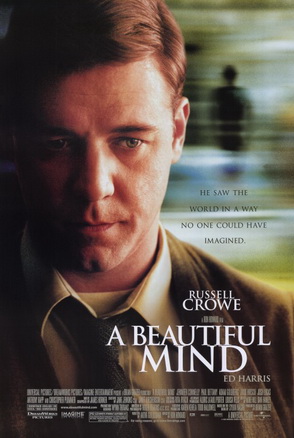
Direct Download Movie A Beautiful Mind (2001)

A Beautiful Mind is a 2001 American biographical drama film based on the life of John Nash, a Nobel Laureate in Economics. The film was directed by Ron Howard, from a screenplay written by Akiva Goldsman. It was inspired by a bestselling, Pulitzer Prize-nominated 1998 book of the same name by Sylvia Nasar. The film stars Russell Crowe, along with Ed Harris, Jennifer Connelly, Paul Bettany, Adam Goldberg, Judd Hirsch, Josh Lucas, Anthony Rapp, and Christopher Plummer in supporting roles. The story begins in Nash's days as a graduate student at Princeton University. Early in the film, Nash begins to develop paranoid schizophrenia and endures delusional episodes while painfully watching the loss and burden his condition brings on wife Alicia and friends.

The film opened in the United States cinemas on December 21, 2001. It went on to gross over $313 million worldwide and win four Academy Awards, for Best Picture, Best Director, Best Adapted Screenplay and Best Supporting Actress. It was also nominated for Best Actor, Best Film Editing, Best Makeup, and Best Original Score.

It was well received by critics, but has been criticized for its inaccurate portrayal of some aspects of Nash's life, especially his other family and a son born out of wedlock. However, the filmmakers have stated that the film was not meant to be a literal representation.


Download

Direct Download Movie Eternal Sunshine Of The Spotless Mind (2004)

Eternal Sunshine of the Spotless Mind is a 2004 American romantic science-fiction comedy-drama film about an estranged couple who have erased each other from their memories, written by Charlie Kaufman and directed by Michel Gondry. The film uses elements of science fiction, psychological thriller, and a nonlinear narrative to explore the nature of memory and romantic love. It opened in North America on March 19, 2004, and grossed over $70 million worldwide.Kaufman and Gondry wrote the story with Pierre Bismuth. The ensemble cast includes Jim Carrey, Kate Winslet, Kirsten Dunst, Mark Ruffalo, Elijah Wood and Tom Wilkinson.

The film won the Academy Award for Best Original Screenplay and has a cult following. Winslet also received an Academy Award nomination for Best Actress.

The title of the film is a quotation from Eloisa to Abelard by Alexander Pope.

Download

Direct Download Movie The Godfather Part II (1974)


The Godfather Part II is a 1974 American epic crime film produced and directed by Francis Ford Coppola from a screenplay co-written with Mario Puzo, starring Al Pacino and Robert De Niro. Partially based on Puzo's 1969 novel The Godfather, the film is both sequel and prequel to The Godfather, presenting parallel dramas: one picks up the 1958 story of Michael Corleone (Pacino), the new Don of the Corleone crime family, protecting the family busineVito Corleone (De Niro), from his Sicilian childhood to the founding of his family enterprise in New York City.

ss in the aftermath of an attempt on his life; the prequel covers the journey of his father,

An Oscar winner for Best Picture, the film received widespread acclaim from critics, with some deeming it superior to the 1972 original. Nominated for eleven Academy Awards and the first sequel to win for Best Picture, its six Oscars included Best Director for Coppola, Best Supporting Actor for De Niro and Best Adapted Screenplay for Coppola and Puzo. Pacino won the BAFTA Award for Best Actor and was nominated for the Academy Award for Best Actor.

Both this film and its predecessor remain highly influential films in the gangster genre. In 1997, the American Film Institute ranked it as the 32nd-greatest film in American film history and it kept its rank 10 years later.[5] It was selected for preservation in the U.S. National Film Registry of the Library of Congress in 1993, being deemed "culturally, historically, or aesthetically significant".

Direct Download Movie The Godfather (1972)


The Godfather is a 1972 American crime film directed by Francis Ford Coppola and produced by Albert S. Ruddy from a screenplay by Mario Puzo and Coppola. Starring Marlon Brando and Al Pacino as the leaders of the fictional Corleone New York crime family, the story spans the years 1945–55, concentrating on the transformation of Michael Corleone from reluctant family outsider to ruthless Mafia boss while chronicling the family under the patriarch Vito.

Based on Puzo's best-selling novel of the same name, The Godfather is widely regarded as one of the greatest films in world cinema—and as one of the most influential, especially in the gangster genre. Ranked second to Citizen Kane by the American Film Institute in 2007 it was selected for preservation in the United States National Film Registry of the Library of Congress in 1990 as being "culturally, historically, or aesthetically significant".

The film was the box office leader for 1972 and was, for a time, the highest-grossing picture ever made. It won three Academy Awards for that year: Best Picture, Best Actor (Brando) and in the category Best Adapted Screenplay for Puzo and Coppola. Its nominations in seven other categories included Pacino, James Caan and Robert Duvall for Best Supporting Actor and Coppola for Best Director. The success spawned two sequels: The Godfather Part II in 1974, and The Godfather Part III in 1990.


Direct Download Movie The Shawshank Redemption (1994)


.In 1947 Portland, Maine, banker Andy Dufresne is convicted of murdering his wife and her lover, and is sentenced to two consecutive life sentences at the fictional Shawshank State Penitentiary in rural Maine. Andy befriends prison contraband smuggler, Ellis "Red" Redding, an inmate serving a life sentence. Red procures a rock hammer and later a large poster of Rita Hayworth for Andy. Working in the prison laundry, Andy is regularly assaulted by the "bull queer" gang "the Sisters" and their leader, Bogs.

In 1949, Andy overhears the brutal captain of the guards, Byron Hadley, complaining about being taxed on an inheritance, and offers to help him legally shelter the money. After a vicious assault by the Sisters nearly kills Andy, Hadley beats Bogs severely. Bogs is sent to another prison and Andy is never attacked again. Warden Samuel Norton meets Andy and reassigns him to the prison library to assist elderly inmate Brooks Hatlen. Andy's new job is a pretext for him to begin managing financial matters for the prison employees. As time passes, the Warden begins using Andy to handle matters for a variety of people, including guards from other prisons and the warden himself. Andy begins writing weekly letters to the state government for funds to improve the decaying library.

In 1954, Brooks is paroled, but cannot adjust to the outside world after 50 years in prison, and hangs himself. Andy receives a library donation that includes a recording of The Marriage of Figaro. He plays an excerpt over the public address system, resulting in him receiving solitary confinement. After his release from solitary, Andy explains that hope is what gets him through his time, a concept that Red dismisses. In 1963, Norton begins exploiting prison labor for public works, profiting by undercutting skilled labor costs and receiving kickbacks. He has Andy launder the money using the alias Randall Stephens.

In 1965, Tommy Williams is incarcerated for burglary. He joins Andy and Red's circle of friends, and Andy helps him pass his GED exam. In 1966, Tommy reveals to Red and Andy that an inmate at another prison claimed responsibility for the murders for which Andy was convicted, implying Andy's innocence. Andy approaches Norton with this information, but the warden refuses to listen and sends Andy back to solitary when he mentions the money laundering. Norton then has Hadley murder Tommy under the guise of an escape attempt. Andy refuses to continue the money laundering, but relents after Norton threatens to burn the library, remove Andy's protection from the guards, and move him out of his cell into worse conditions. Andy is released from solitary confinement after two months, and tells Red of his dream of living in Zihuatanejo, a Mexican coastal town. Red feels Andy is being unrealistic, but promises Andy that if he is ever released, he will visit a specific hayfield near Buxton, Maine, and retrieve a package Andy buried there. Red becomes worried about Andy's state of mind, especially when he learns Andy asked another inmate to supply him with six feet of rope.

The next day at roll call, the guards find Andy's cell empty. An irate Norton throws a rock at the poster of Raquel Welch hanging on the wall, and the rock tears through the poster. Removing the poster, the warden discovers a tunnel that Andy dug with his rock hammer over the last 17 years, hidden by posters of starlets Andy acquired from Red over the years. The previous night, Andy escaped through the tunnel and used the prison's sewage pipe to reach freedom, bringing with him Norton's suit, shoes, and the ledger containing details of the money laundering. While guards search for him the following morning, Andy poses as Randall Stephens and visits several banks to withdraw the laundered money. Finally, he mails the ledger and evidence of the corruption and murders at Shawshank to a local newspaper. The police arrive at Shawshank and take Hadley into custody, while Norton commits suicide to avoid arrest.

After serving 40 years, Red is finally paroled. He struggles to adapt to life outside prison and fears he never will. Remembering his promise to Andy, he visits Buxton and finds a cache containing money and a letter asking him to come to Zihuatanejo. Red violates his parole and travels to Fort Hancock, Texas, to cross the border to Mexico, admitting he finally feels hope. On a beach in Zihuatanejo, he finds Andy, and the two friends are happily reunited
 
Copyright © 2015. MuviDux